Showing posts with label Margarita Engle. Show all posts

Friday, June 9, 2017

Margarita Engle's _The Surrender Tree: Poems of Cuba's Struggle for Freedom_

The Surrender Tree: Poems of Cuba's Struggle for Freedom (2008) was the first verse novel by Margarita Engle that I encountered years ago. It is the first book in Engle's "loosely linked group of historical verse novels about the struggle against forced labor in nineteenth-century Cuba" (Lion Island, 160). The Surrender Tree was a 2009 Newbery Honor Book, only the third verse novel to be recognized by the Newbery committee after Marilyn Nelson's Carver: A Life in Poems (2002) and Karen Hesse's Out of the Dust (1998)Engle was the first Latinx author to receive a Newbery honor.

The Plot: In Engle's The Surrender Tree, poems alternate among the voices of five primary characters to tell a story based upon historical events as well as Engle's own great-grandparents' experiences during Cuba's fight for independence. It take place between 1850 and 1899, during which time three different wars rage in Cuba. The narrative follows Rosa, a healer and nurse; Lieutenant Death, a slavehunter; Jose, Rosa's husband; Weyler, a captain-general of Spain who instituted concentration camps in Cuba to control the rural civilian population; and Silvia, an eleven year old girl from a small farm who comes to learn from Rosa after her family starves in the concentration camps.

The Poetry: The most striking poems in this collection are told in the voices of Rosa and Silvia and meditate upon the natural world as a healing balm for war and sorrow. For instance, in an early poem, Rosa describes the burning city of Bayamo:

I watch the flames, feel the heat,
inhale the scent of torched sugar
and scorched coffee....
I listen to voices,
burning a song in the smoky sky. (28)
Imagery, language, and metaphor are at work in this poem to evoke the sense of beauty and danger brought on by the violence of war. The internal and slant rhymes in the first three lines ("watch," "torched," "scorched") emphasize the crackling sound of the flames, while the image of "voices, / burning a song" links the lives of the people to the fire that engulfs the city. Later in the verse novel, the poems told from Silvia's view point evoke the same lyricism and imagery. In one poem, the speaker describes how the driver of an oxcart helps her steal away from the concentration camp: "He points to a hole int he fence, / puts his finger to his lips, / then draws a map in the sky--" (103). Again, the sky figures heavily into the narrative, and silence lingers at the end of each line of poetry.

The Page: Engle's verse novel is divided into five parts: "The Names of Flowers, 1850-51," "The Ten Years' War, 1868-78," "The Little War, 1878-80," "The War of Independence, 1895-98," and "The Surrender Tree, 1898-99." The novel begins with a dedication and explanation of the historical roots for the narrative, as well as a quote from a poem by Jose Marti. It concludes with an author's note, a historical note, a chronology, selected references, and acknowledgements.

I give The Surrender Tree four stars.

Friday, June 2, 2017

Margarita Engle's _Hurricane Dancers: The First Caribbean Pirate Shipwreck_

The Plot: In Hurricane Dancers: The First Caribbean Pirate Shipwreck (2011), a 2012 Pura Belpre Honor Book, Margarita Engle tells a story alternating five characters' perspectives: Quebrado, a young slave of Taino Indian and Spanish ancestry; Bernardino de Talavera, a real-life conquistador who became the first pirate of the Caribbean Sea in the 1500s when he stole a boat to avoid debtors' prison; Alonso de Ojeda, a brutal European slave trader and conquistador who was taken prisoner by Talavera; and two young islanders who are secretly in love -- Caucubu, the daughter of a Ciboney chieftain, and Narido, a fisherman. Engle invented the character Quebrado, but the remaining characters are all historical figures-- two European and two Cuban. Engle reveals in her author's note that she "became fascinated by the first Caribbean pirate shipwreck while researching [her] own family history" as one of her ancestors "was a Cuban pirate who used his treasure to buy the cattle each where many generations of [her] mother's family were born" (135). She notes further that she became the subject of the Cuban DNA project and discovered that she carries a genetic marker verifying tens of thousands of years of maternal Ameindian ancestry; Engle is "a descendant of countless generations of women like Caucubu. Indigenous Cubans do survive in body, as well as spirit" (135).

The Poetry: The majority of Hurricane Dancers meditates upon the enslaved life of Quebrado, who is referred to as "broken boy," "spirit-boy," "storm-boy," and "born-of-wind friend" by various characters throughout the narrative. While the experiences of the other characters in the narrative are interesting, the poems told from Quebrado's perspective are the most lyrical and lively on the page. For instance, the first poem in the collection "Quebrado," begins:
I listen
to the song
of creaking planks,
the roll and sway
of clouds in sky,
wild music
and thunder,
the groans
of wood,
a mourning moan (3).
The poem ends as the speaker links the old ship's sounds with the materials used to create it, explaining that the sounds echo the ship's memory of "her true self / her tree self / ... alive" (3). Poems like this one, steeped in metaphor reflecting the natural world and ringing with sound and rhythm, are characteristic of those told from the point of view of Quebrado.

The Page: Hurricane Dancers is divided into six parts: "Wild Sea," "Brave Earth," "Hidden," "The Sphere Court," "The Sky Horse," and "Far Light." Engle begins her verse novel with a quote uttered by Caliban in William Shakespeare's The Tempest and a description of Talavera from Bartolome de las Casas's History de las Indias; a note on her historical setting; and a list and description of the cast of characters. The verse novel ends with an author's note; a historical note detailing her narrative's connection to historical characters and events, culture and language, and literature; and a list of references.

I found Hurricane Dancers to be extremely engaging, and I thoroughly enjoyed Engle's characteristic use of free verse, lyricism, and imagery within her historical narrative. I give Hurricane Dancers four stars and highly recommend it.

Friday, May 26, 2017

Margarita Engle's _The Wild Book_

The Plot: The Wild Book (2012) by Margarita Engle is verse novel inspired by the stories and experiences Engle's maternal grandmother told her about her childhood growing up in Cuba in the early 1900s. As she explains in her author's note, the verse novel follows Fefa (Josefa de la Caridad Uria Pena) who lives on a small farm in the countryside during a time of "chaos following Cuba's war for independence from Spain and the subsequent US occupation of the island. It was a time of lawlessness, when bandits terrorized the countryside, kidnapping children unless their families agreed to deliver ransom money" (123). From the first poem in the collection, readers learn that Fefa has "word-blindness" (3)-- "a medical term used in the early twentieth century for what we now call dyslexia" (125). The narrative focuses on Fefa's struggle with dyslexia and learning to read and write through poetic exploration, as well as Fefa's encounter with Fausto, her family's old farm manager, who writes a sloppy "ugly" poem in her honor (42); Fefa is mortified by Fausto's attention.

The Poetry: Like many other of Engle's verse novels, The Wild Book employs free verse, lyricism, and imagery to tell the story of a young girl's experiences. The Wild Book in many ways shows a young girl developing a love for reading poetry and writing in her own wild book, which her mother gives to her upon her diagnosis with word-blindness: "Think of this little book / as a garden, / Mama suggests" (5-6). Her mother advises her to view her writing as a path to maturation and self-acceptance:
Throw wildflower seeds
all over each page, she advises.
Let the words sprout
like seedlings,
then relax and watch
as your wild diary
grows. (6) 
And eventually, a love of language emerges within Fefa. She exclaims later in the collection in a poem entitled "Fly to the Truth of Dreams" that she "love[s] the way poetry / turns ordinary words / into winged things" (68). In addition to the imagery and lyricism Engle relies upon, she also utilizes repetition and the space on the page to emphasize the ways in which Fefa's struggle with dyslexia manifests itself, as well as how she begins to find ways to allow herself to experience more comfort and pleasure in language.

The Page: Engle's verse novel begins with a dedication "for young readers who dread reading and for those who love blank books" which answers one of the chargers that the verse novel form is ideal for reluctant readers. This dedication is followed by a quote in Spanish with a translation from the poet Ruben Dario, who is referred to throughout the narrative as the Fefa's mother's favorite poet. The quote reads: "In the hour of daydreams my eyes watched / the blank page // And there came a parade of dreams and shadows" (from "La Pagina Blanca" or "The Blank Page"). This epigraph complicates Engle's dedication in that it demonstrates the complexity and intertextual, cross-cultural references made throughout the collection. The book ends with an author's note that includes a family photograph of Fefa from 1914 and an acknowledgements section.

I thoroughly enjoyed The Wild Book; I give it four stars and highly recommend it.

Monday, May 22, 2017

Margarita Engle's _The Firefly Letters_

On May 11, 2017 Margarita Engle was named the Young People's Poet Laureate by the Poetry Foundation. Engle follows Jacqueline Woodson, who was the previous honoree in 2015. As I've noted in previous reviews of Engle's work on this blog, Engle is a prolific verse novelist; she has published eleven verse novels to date (four of which I have reviewed here)-- one every year since 2008. Over the next year, as part of this blog's focus on the geneology of the verse novel, I will review the remaining six verse novels written by Engle, which date back to 2006.

The Plot: Engle's 2010 verse novel The Firefly Letters: A Suffragette's Journey to Cuba is the second book in her "loosely linked group of historical verse novels about the struggle against forced labor in nineteenth-century Cuba" (Lion Island, 160). Winner of a Pura Belpré Honor for narrative, The Firefly Letters is a polyvocal verse novel that tells the story of real-life historical figure Fredrika Bremer (1801-65) who traveled to Cuba in 1951 for three months and interacted with a fifteen-year-old African-born enslaved translator named Celia. Engle's narrative follows these two women and her invented twelve-year-old character Elena. Bremer, as Engle explains in her historical note, was Sweden's first female novelist and one of the world's earliest advocates of equal rights for women (146). The Firefly Letters combines the voices of Fredrika, Celia, and Elena to explore the struggles facing women from different backgrounds, of different ages, and of different races toward equality.

The Poetry: While I found Engle's verse novel rich in terms of narrative, The Firefly Letters lacked some of the more arresting lyricism and imagery evident in many of Engle's more recent verse novels. The elements of poetic form that The Firefly Letters employs include the use of free verse and the space on the page, the blending of voices (each poem is titled by the character speaking's name), and the occasional bit of imagery or use of metaphor. One such passage appears in the poem told from Elena's point of view where she describes the folds in cloth as stirring "in the sea breeze, / moving with a sigh / like wings" (139). In this poem, Elena is meditating upon a secret plan she has to help better Celia's life that involves her smuggling expensive fabrics from her house. The "e" sounds in the first quoted line enact the "sigh" mentioned in the second line, while the final line that describes the movement of cloth as that of wings alludes to a possible freedom or movement toward hope.

The Page: Within the 144 pages of the verse novel, poems alternate between the three characters' points of view. The narrative is book-ended with a quote from a letter from Bremer to the Queen of Denmark describing her visit to Cuba and a historical note, an author's note, acknowledgements, and references. Engle cites Bremer's New Sketches of Every-Day Life (1850) as comprising the "most complete known record of rural daily life on the island [of Cuba] at that time" (146).

I give Engle's The Firefly Letters four stars. Look forward to my reviews of Engle's verse novels from published between 2006 and 2012, as well as her newest 2017 verse novel in the coming months.

Friday, April 14, 2017

Margarita Engle's _The Lightning Dreamer: Cuba's Greatest Abolitionist_

The Plot: Margarita Engle's verse novel The Lightning Dreamer: Cuba's Greatest Abolitionist (2013), a 2014 Pura Belpre Honor Book, is a work of historical fiction based upon the life and writing of Gertrudis Gomez de Avellaneda (Tula) a poet, playwright, and novelist who lived from 1814-73. Avellaneda's boldest and most well-known work is Sab, "one of the world's first abolitionist novels and the earliest one written in Spanish. Sab is also the only known Latin American abolitionist novel that combines proemancipation views with feminist themes" (170). The Lightning Dreamer begins in 1827 when Tula is thirteen years old and is told from alternating viewpoints (including those of Tula, her younger brother Manuel, her mother, her maid Caridad, the Nuns whose library Tula often visits, the Orphans at the theater, and a young boy named Sab). The narrative follows Tula through 1836 when she is twenty-one years old and details her experiences on the marriage market, the blossoming of her passion for writing through discovery of Cuban Romantic poet Jose Maria Heredia's work, and her journey to Havana to write her novel.

The Poetry: Engle's verse novel is full of lyrical verse that combines imagery and metaphor to tell the story of a burgeoning young writer growing up in a time of oppression and injustice. At times Engle employs spare, rhymed verses in her narrative, such as: "I am alone / and my heart / is my own" (108). In other poems in the collection, Tula meditates upon the power of poetry's rhythms and silence: "I study verses with a drumbeat rhythm / like pounding music," "just as often, poetry is a free / dance / of birds in air," and "in each verse; / the stillness / between words" (45). Still other poems ask poignant questions about authenticity and the ethical implications of writing the story of injustices experienced by others:
Can a woman ever write
the true thoughts of a man?
...........................................
Can a free person
really understand one whose dreams
must fly up and soar
high above the depths
of slavery?

Is my imagination enough,
or do I need to add the ways
in which I myself
have felt enslaved? (162).
The Page: The Lightning Dreamer is divided into five parts: "Suns and Rays," "The Orphan Theater," "The Marriage Market," "See Me as I Am," and "The Hotel of Peace." The poems included in these sections are also book-ended by sections containing historical background and notes on the writing of Avellaneda and her mentor Heredia, as well as references. Engle also provides samples of poetry and prose written by both Avellaneda and Heredia in Spanish and with English translations.

Engle has written ten verse novels, several of which I have reviewed. The Lightning Dreamer is my favorite of Engle's verse novels for young readers. I give it five stars and highly recommend it.

Saturday, December 31, 2016

VNR's Fav. Five of 2016

Happy end of 2016! This year I reviewed 45 verse novels published in the past four years; I would categorize nineteen of the verse novels I reviewed this year as excellent (four and five stars). To celebrate the end of the year, I have chosen my five favorite verse novels that were published in 2016. Each of the verse novels below skillfully combine poetic form and technique with a compelling narrative and add something new to the body of poetry for young readers. You can find my original reviews of each verse novel linked below. Looking forward to a new year filled with even more fantastic verse novels for young readers!

Kwame Alexander's Booked


Jeannine Atkins's Finding Wonders: Three Girls Who Changed Science


Margarita Engle's Lion Island: Cuba's Warrior of Words


Nikki Grimes's Garvey's Choice


Marilyn Nelson's American Ace


Friday, September 16, 2016

Margarita Engle's _Lion Island: Cuba's Warrior of Words_

The Plot: Margarita Engle's newest verse novel, Lion Island: Cuba's Warrior of Words (2016), is the fifth and final volume in what she calls her "loosely linked group of historical verse novels about the struggle against forced labor in nineteenth-century Cuba" (160). And it is a lovely and powerful work that follows three young, culturally diverse protagonists: twelve year old Antonio, a messenger boy with Asian, African, and European ancestry who eventually becomes a translator  (based upon the historical figure Antonio Chuffat-- a champion of civil rights for the Chinese Cuban community); Wing, a fourteen year old Chinese American boy whose family barely escaped the anti-Asian riots in San Francisco; and his twin sister, Fan, a talented singer and performer. Antonio, Wing, and Fan's stories intertwine to tell the tale of how a group of young friends worked hard to tell their stories and have their voices heard in a time of violence, with injustice, war, and rebellions swirling around them. Antonio works to record, translate, and help give voice to the experiences of those enslaved Africans and near-enslaved Chinese indentured servants who were forced or coerced to sign eight-year contracts to work in the fields of Cuba, while Wing's story leads him to eventually join the rebellion and Fan runs away from home to work at el teatro chino as a singer who assists runaways in hiding on their way to escaping enslavement.

The Poetry: As previously noted, Engle is a prolific verse novelist for young readers, having published nine well-received, award winning verse novels before Lion Island. This volume contains beautiful poetry, and I found the poems which Fan is the speaker of to be particularly moving as she longs to become an artist. Engle's use of imagery, lyricism, and metaphor contribute richly to her work. The poem "That Same Evening" in which the speaker Wing describes being robbed by Spanish soldiers ends with two rhythmic stanzas describing his emotions: "Rage comes and goes in gusts, / like a hurricane's furious / wind" and "Quietly, I return to work the next day, / trapped in the eye of my own / storm" (41). The quiet rhythm and movement on the page of these two stanzas enacts the content of the poem, tracing the rise and fall of the wind as well as Wing's anger. Later in the narrative, in the poem "Mirror," Fan meditates upon her experiences of being a young woman and the twin sister of a passionate brother:
Being the twin of a boy
is like shimmering
in and out of a shiny river,
the constant burst of rushing water
never peaceful enough to see my own
reflection (52).
Toward the end of this same poem, Fan notes that her brother can go anywhere and so or say whatever he pleases, while as a young woman she must constantly guard herself and speak and dream with caution. While Fan and Wing's stories are significant to the narrative, Antonio's experiences are the underlying drive of the work. In the poem "Quiet Truths" toward the end of the verse novel, Antonio examines his place as messenger, translator, and activist,

How difficult it is to describe injustice.
No wonder Fan used a knife on wood,
or a stick in mud, before discovering
her own songs.
.......................................................... 
There's nothing a warrior of words can do
for people who have already been murdered,
nothing but offer comfort so that the living
can begin to feel peaceful in the presence
of memories (142).
This seems to be the overall drive of Engle's series of historical verse novels that examine the struggles and injustices faced by so many during this time period in Cuba. Engle's Lion Island and her series as a whole draw attention to these experiences and histories.

The Page: Lion Island includes seven sections of poems: "Running with Words: Year of the Goat 1871," "The Beast of Hope: Year of the Monkey 1872," "Free Songs: Year of the Rooster 1873," "The Shadow Path: Year of the Rooster 1873," "Dangerous Flames: Year of the Rooster 1873," "Listeners: Year of the Dog 1874," and "Voices Heard Across the Sea: Year of the Tiger 1878." Engle's verse novel is not only rich in poetry and plot, but Lion Island also includes sections book-ending the narrative focused on historical background. Engle includes sections not only about Cuban history, but also about historical figures, and she provides a reference section and further readings for young people.

I give Engle's Lion Island: Cuba's Warrior of Words four stars and highly recommend it.

Friday, April 29, 2016

Margarita Engle's _Silver People: Voices from the Panama Canal_

Earlier this year I reviewed Margarita Engle's Enchanted Air which focuses on US-Cuban relations during the 1950s and 1960s, as well as Engle's own experience growing up and traveling between her two homelands. Once again, in Silver Peeople: Voices from the Panama Canal, Engle explores the Cuban perspective specifically, and Latin American history more generally in this narrative.

The Plot: Engle's 2014 verse novel, Silver People is a polyvocal narrative that includes poems in the voices of imaginary characters, historical figures, and native plants and animals in Panama's forests. Silver People takes its title from the discriminatory silver/gold payroll system in the American-ruled Canal Zone during the construction of the Panama Canal. The verse novel takes place between the years of 1906 and 1915. The narrative begins by introducing the reader to Mateo, a 14-year-old orphaned boy from Cuba, who boards a steamship to Panama after an American Panama Canal recruiter promises food, housing, and pay for his labor. After an arduous journey at sea with no food for three days, Mateo arrives in Panama, and he finds that the recruiter's promises are not truthful. The work is grueling, the working and living conditions are poor, and workers often become ill with malaria and yellow fever. Despite these hardships and the racial discrimination faced by the young laborers, Mateo and his companions manage to make a life for themselves in Panama. Early on in the narrative, he befriends Anita, a local yerbera, or herb girl, and a Jamaican boy named Henry. The narrative alternates between the voices of Engle's imagined characters: Mateo, Anita, Henry, Old Maria (Anita's adoptive grandmother), and Augusto (a Puerto Rican with a PhD in geology from a New York university) and historical figures such as John Stevens, Theodore Roosevelt, George Goethals, Jackson Smith, Gertrude Beeks, and Harry Franck. Engle also includes eight sections of poems that are told from the imagined voices of native plants and animals in the forest including: howler monkeys, trees, vipers, butterflies, crocodiles, and frogs. The inclusion of these personified voices demonstrates the ways in which the landscape of Panama and the individuals who labored on the canal are intimately connected in that both were harmed immeasurably. The epilogue to the verse novel is a letter from Augusto to Mateo, Anita, and Henry noting that at the San Francisco Panama-Pacific International Exposition fails to honor the silver people who labored and died in the construction of the canal.

The Poetry: Engle is the author of nine verse novels for young readers, and her tenth is scheduled for publication in August. Like Engle's many other verse novels for young readers, Silver People relies heavily upon the use of lyricism and imagery to depict the natural world and the emotional lives of her characters. For example, in the poem "The Voyage from Cuba" Mateo reflects upon hunger and the experience of being at sea for three days:
feels like a knife in the flesh--
twisted blade, rusty metal
the  piercing tip of a long
sharp-edged
dagger
called regret (10).
Later in the narrative, Augusto the map maker provides Mateo with art supplies and he begins to sketch the wonders of the forest around him. In the poem "Completely Magnificent" he describes the animals he paints:
two swiftly sprinting whiptail lizards,
and all the gigantic rodents that graze
on gold-zone lawns-- cat-size agoutis
and dog-size capybaras, none of them
afraid to be captured
by my paintbrush (131).
The Page: In terms of form, Engle's verse novel is primarily told through free verse poems in the alternating voices of eleven characters. Each section of poems in the voices of human characters is separated by a section called "The Forest," and in these eight sections, Engle depicts the voices of plants and animals as they respond to the canal's construction. These poems often take the form of visual poetry (shaped verse or concrete poetry). For example, the poem "The Giant Hissing Cockroaches" includes short phrases alternatively right and left justified so that the words appear to flit across the page, mimicking the movement of the cockroach (104).


Engle's Silver People was an interesting and engaging narrative, and she employs her signature lyric free verse to represent a historical moment and give voice to the Cuban experience. I give Silver People four stars and recommend it to those who already enjoy Engle's verse novels.

Friday, January 22, 2016

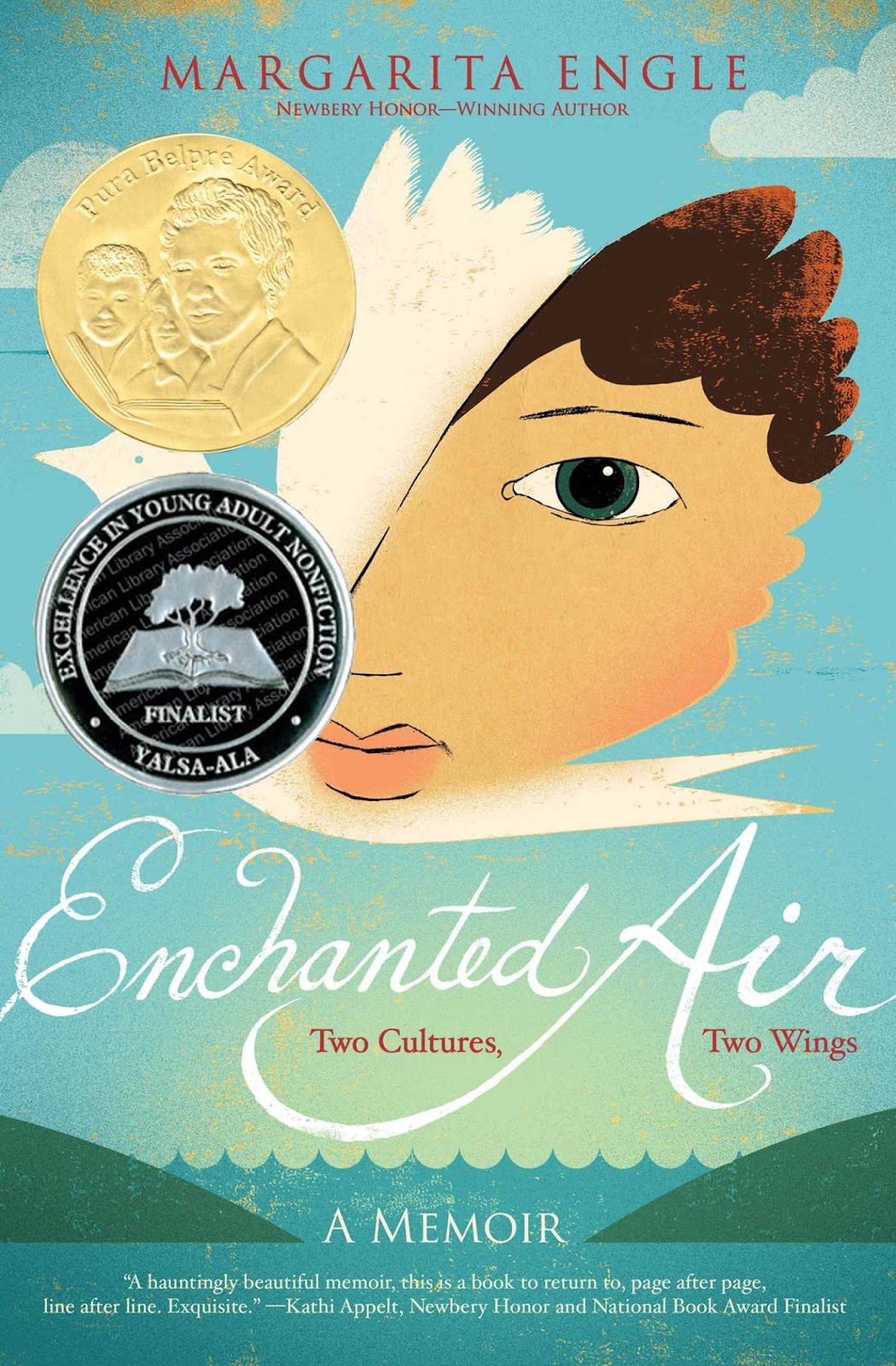
Margarita Engle's _Enchanted Air: Two Cultures, Two Wings: A Memoir_

Last Monday the American Library Association announced the 2016 youth media award winners. Margarita Engle's 2015 Enchanted Air was named the winner of the Pura Belpré author award. According to the ALA's website, the Pura Belpré award is presented annually to a Latino/Latina writer and illustrator whose work best portrays, affirms, and celebrates the Latino cultural experience in an outstanding work of literature for children and youth. Enchanted Air was also a finalist for the YALSA Award for Excellence in Nonfiction for Young Adults ages 12 to 18.

The Plot: Engle's work follows other recent examples of memoirs in verse such as Jacqueline Woodson's Brown Girl Dreaming and Thanhha Lai's Inside Out and Back Again in that it explores the author's childhood experiences of "otherness" during tumultuous periods in US history. Enchanted Air: Two Cultures, Two Wings is composed of what Engle refers to in her author's note as "travel memories" from the first fourteen years of her life (191). The novel's dust jacket begins: "Margarita is a girl from two worlds." The young protagonist describes her life from 1951 through 1965 growing up in Los Angeles and frequently visiting her mother's homeland of Cuba. The first half of the narrative focuses on the magic Margarita experiences visiting Cuba and learning about the language and landscape of the island. As the years pass, revolution breaks out in Cuba and US-Cuban relations become strained by the events of the Cold War. As a middle-schooler, Margarita struggles to find her place and longs to return to Cuba. Eventually travel to Cuba becomes completely restricted, and Margarita's family travels to Europe instead.

The Poetry: Enchanted Air utilizes short, one to two page free verse poems and the poems are divided into four sections entitled "Magical Travels," "Winged Summer," "Strange Sky," and "Two Wings." These four sections are framed by a prose introduction "Love at First Sight" (which describes how Margarita's parents met and fell in love) and a Cold War timeline and author's note. Engle's poetic strength throughout her memoir in verse is her use of lush imagery and metaphor, particularly in her descriptions of the natural landscape. For instance, in her poem "The Dancing Plants of Cuba" she describes how "Fronds and petals wave / in wild wind" and
The delicate leaflets
of sensitive mimosa plants
coil and curl, folding up
like the pages
of a wizard's book,
each time I touch
their rooted magic (12).
Moments like these accumulate throughout the early pages of her verse novel. Engle also utilizes subtle rhymes occasionally which contribute to the musicality of the narrative. As the narrative progresses, more and more time is spent focusing on the protagonist's longings and memories of her relatives and the Cuban countryside.

The Page: The poems in Engle's collection focus on the repeated themes of doubles and wings throughout. This is most evident in the various poems that are titled in both Spanish and English. Poems such as "Realidad/Reality" and "Hasta Pronto/Until Soon" are only found in the first two poetry sections that take place before 1961 when Margarita and her family are able to travel to Cuba. In the final section, in the poem "My Second Wing" the speaker of the poem meditates on her realization after visiting Spain that "other journeys / are magical too" and that she "can love / many countries, / not just two" (183).

Engle's use of imagery and metaphor in Enchanted Air were lovely. I give her memoir in verse four stars.

Friday, January 1, 2016

An Introduction to the Verse Novel Review

Welcome to The Verse Novel Review! This blog features my reviews, critical perspectives, analysis, and exploration of the verse novel for young readers as a literary form. I am a children's and young adult literature scholar and educator who studies form in contemporary American poetry, comics, and realistic fiction.

I first became interested in the verse novel as a form while I was completing my MFA in Poetry. I read hundreds of children's, young adult, and adult verse novels and even experimented with writing my own verse novel. Throughout my research and writing process, I was most struck by the fact that although this form has deep historical roots and has been utilized by many contemporary adult writers (such as Anne Carson, Rita Dove, Marilyn Hacker, Derek Walcott, and Seth Vikram), the form has emerged strongly in literature for young readers from the 1990s onward. Karen Hesse's Out of the Dust was the first verse novel for young readers to win the Newbery Medal in 1998, and Virginia Euwer Wolff's True Believer and Thanhha Lai's Inside Out and Back Again each won the National Book Award for their verse novels in 2001 and 2011, respectively. Most recently, verse novels such as Kwame Alexander's The Crossover and Jacqueline Woodson's Brown Girl Dreaming have been awarded top honors by the Newbery Medal Selection Committee and the National Book Award panel. Beyond awards and honors, verse novels for young readers have also emerged as a form extremely popular with young people. Verse novels by Ellen Hopkins, Margarita Engle, David Levithan, Sonya Sones, Sharon Creech, Helen Frost, among others can regularly be found in stock at large chain bookstores.

Further research into the critical opinion about the verse novel for young readers uncovered a general feeling of suspicion and distaste for the form (see the bibliography of critical perspectives page on this blog, noting critical commentary from the panel for The Lion and the Unicorn Award for Excellence in North American Poetry in 2005, 2009, and 2014). Critics have debated about whether there is any poetry in the verse novel and whether the form merits serious critical consideration. This led me to wonder: Why the verse novel? What is the verse novel? Why have authors for young readers found the form useful to communicate to and about children in the twentieth and twenty-first century? Why have critics of verse novels for young readers found the form lacking at times? What makes the verse novel for young readers a valuable form? I hope to use this blog as a way to open up a dialogue about the form and to begin answering these questions. I also hope to use this blog as a place to begin tracking, organizing, categorizing, and recognizing patterns in the production, consumption, and content of the verse novel for young readers.

Although many have defined the verse novel, it is not only scholars, but also readers, authors, and publishers who help determine what makes a book a verse novel. What makes the verse novel unique is its hybrid form, a form that combines elements of poetry, prose, and even drama (see Mike Cadden's "The Verse Novel and the Question of Genre" for more on this idea). I define the verse novel as a series of poems linked by a central narrative thread. Furthermore, because of the strong connection between children's and young adult literature and participatory culture, I argue that if a publisher, author, scholar, or reader identifies a work as a verse novel, it is a verse novel.

The verse novel as a form is significant in that, in both children's and adult literature, it has a literary history and tradition that dates back to the late eighteenth and early nineteenth century. Since the late 1990s, the verse novel has reemerged within both children's and adult literature, marking an important shift in the way in which we view contemporary poetry. The verse novel, in its unique hybrid construction, opens up a space for young readers and educators to come to contemporary poetry without feeling overwhelmed. The verse novel presents itself as an accessible form, and quite often reveals much depth and complexity through its language and craft.

So welcome to the blog! You can look forward to my posts weekly. I will be reviewing a new verse novel for young readers each week beginning with those published most recently in 2014 and 2015, with an occasional post about what I will call "genealogical" works from 1990 through 2013. I will provide discussion of elements of the plot, the poetry, and the page, as well as note my rating on a five-star scale system. Cheers to a new year full of verse novels!